

NICEs report Principles for Best Practice in Clinical Audit was published in March 2002. The report will help NHS staff learn lessons from everyday practice to help them improve the care delivered to patients. The report was published in response to demand from healthcare professionals throughout the NHS who are keen to develop effective tools to review their practice.
Follow this link for a copy of the report: http://www.nice.org.uk/pdf/BestPracticeClinicalAudit.pdf
The first ever clinical audit was reputedly undertaken by Florence Nightingale during the Crimean War in the mid-19th century. Since then, the progress of clinical audit within the NHS can be separated into three distinct eras:
Since the Working for Patients White Paper was published, the Department of Health have issued three definitions of clinical audit in 1989, 1993 and 1996. All three definitions are extremely long and unwieldly, with the most recent definition (1996) stating
Clinical Audit is a clinically led initiative which seeks to improve the outcomes of patients care through structured peer review whereby clinicians examine their practice and results against agreed standards and modify their practice where indicated.
Although the 1996 DoH definition is clearly accurate, Leicestershire PCAG prefer to define clinical audit in much more simplistic terms
Clinical Audit is a structured process which ensures we are carrying out best practice by reviewing what we are doing, compared with what we should be doing.
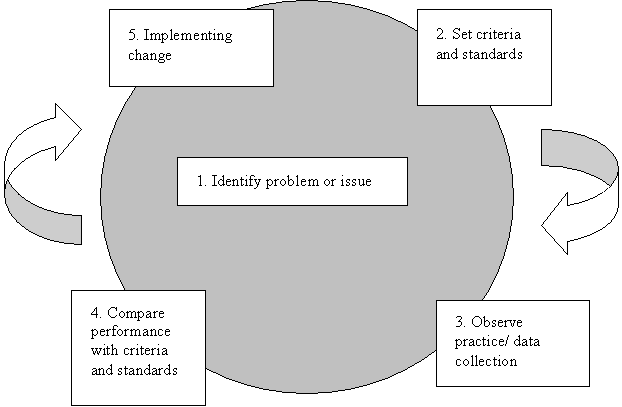
The clinical audit cycle (also referred to as the audit spiral, audit loop, etc) sets out the various steps that must be undertaken to ensure that an audit project is systematic and successful.
The following diagram graphically illustrates the clinical audit cycle.
|
|
||
|
||
|
|
In order to carry out a successful audit, the audit team should work round the various stages of the audit cycle. These are as follows:
1. Selecting an appropriate audit topic
The first stage of any audit is obviously to select an appropriate topic to be audited. However, selecting an appropriate audit topic isnt as straight-forward as it may appear. It is important that your audit topic focuses on a real problem and that it is also measurable and relevant to your field of work/practice.
2. Choosing appropriate criteria and standards
Criteria and standards are two audit terms which often confuse people. This is unfortunate, as criteria and standards are not difficult to understand. In essence, if we refer back to our definition of audit, criteria and standards relate to what we should be doing.
A criterion is essentially an item of care or an aspect of practice that we can use to assess quality. Each criterion should be recorded as a succinct statement. Therefore, an example of a criterion would be The records show that patients with CHD are reviewed annually.
A standard is a statement of the proportion of occasions or patients which must fulfil each criterion. Standards are expressed as percentages. For example, we may set a standard stating that 100% of CHD patients should have an annual review recorded in their records.
Criteria and standards should be based on the latest available research and evidence. If evidence is not available, it is acceptable to base criteria and standards on a consensus agreement by members of the team.
3. Collecting Data
Once you have set the criteria and standards for your audit (i.e. decided what you are going to measure against) you will need to collect audit data. There are a number of factors to consider at this point.
First, audit data must be representative and therefore you will need to ensure that enough patients are included in the audit to make sure that the data collected is valid and representative. Second, it is important to make sure that any data collection forms used are understandable, consistent and robust. If two people using the same audit data collection form interpret the questions and data differently, the audit will be prone to failure. Therefore, in order to make sure data collection forms are valid, it is advisable that teams pilot their data collection tools thoroughly.
In recent times, NHS staff have started to move from manual collection of audit data to the electronic capture of data. This is clearly more preferable as electronic capture of data is likely to be much quicker and more accurate. However, it is important that electronic audit tools are thoroughly checked, as problems can still emerge.
4. Analysing Data
Once audit data has been collected it needs to be analysed. Often staff assume that analysis of audit data is a highly scientific and mathematical process, but this is not the case.
In most instances, analysis of audit data simply involves calculating basic percentages. For instance, using our earlier example, the team would firstly focus on the actual percentage of CHD patients who had no record of an annual review in their notes. This calculation would inform the practice if they were meeting the expected standard or not.
Audit data should also be analysed to identify particular trends and problems. For example, using our CHD example once again, analysis of the audit data might reveal that a particular group of patients is not being reviewed annually (e.g. housebound patients), or that recently diagnosed CHD patients are not being invited back for a review after a year.
5. Implementing Changes
The penultimate stage of the audit cycle is one of the most crucial and often also one of the most difficult.
Once all audit data has been analysed and the audit results calculated, the audit team need to decide what changes need to be implemented. Obviously, changes should be designed to rectify any major problems that the audit has identified.
Implementing changes that will be effective and lead to improvements is complex. In some cases, subtle changes will lead to considerable improvements. However, in other instances, major changes will need to be set in place.
Whatever changes result from an audit, it is vital that the change process is not left to chance. In other words, a detailed audit action plan should be made stating exactly who, when, what and how changes are to be implemented. Further, all members of the team should be informed of the proposed changes and someone should take a lead role in overseeing that the changes take place.
6. Re-Audit
The final phase of the audit cycle is to undertake a re-audit, i.e. recollect audit data and analyse this. The main purpose of the re-audit phase is to find out if the changes that were implemented have led to an improvement.